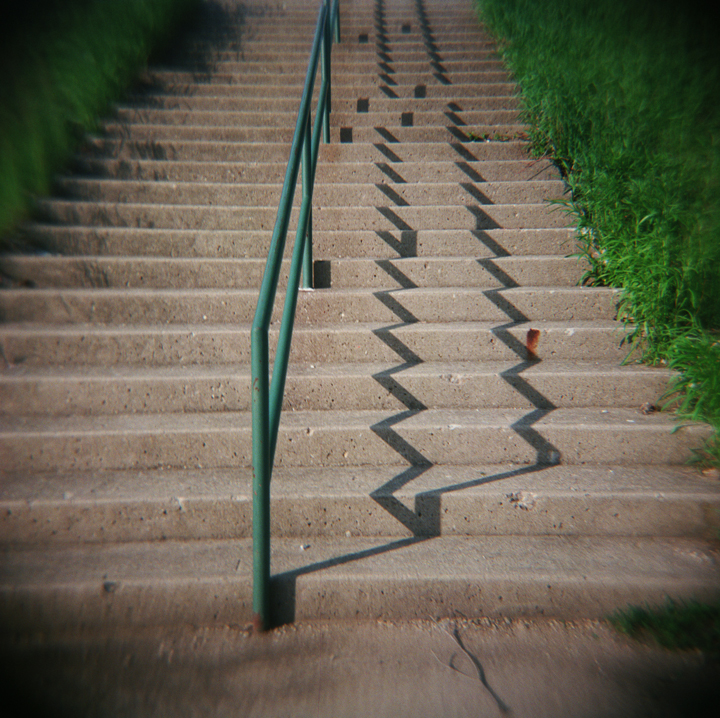
I've become quite fond of my Holga 120N camera over the past year. I've ran a number of different film styles through it and I've shot it in various lighting conditions and settings. I've had great results; I've had good results and I've had bad results. It's all part of the fun with film and the Holga. My latest Holga experiment came on my recent trip to San Francisco and Sonoma. I shot a roll of Lomography 100 Color Negative film and a roll of Kodak Tri-X 400 (which was shot with a Holga red filter). The color negative was shot on Alcatraz and around Fisherman's Wharf. The Tri-X was shot in Sonoma and the rest of the roll was finished up in Ohio at the Hobart Nature Preserve. I was pleased with the results; I hope you enjoy them as well.
Camera: Holga 120N
Film: Lomography 100 Color Negative
Camera: Holga 120N with Holga Red Filter
Film: Kodak Tri-X 400
Camera: Holga 120N
Film: Lomography 100 Color Negative
Camera: Holga 120N with Holga Red Filter
Film: Kodak Tri-X 400
Camera: Holga 120N
Film: Lomography 100 Color Negative
Camera: Holga 120N with Holga Red Filter
Film: Kodak Tri-X 400
Camera: Holga 120N
Film: Lomography 100 Color Negative
Camera: Holga 120N with Holga Red Filter
Film: Kodak Tri-X 400
Camera: Holga 120N
Film: Lomography 100 Color Negative
Camera: Holga 120N with Holga Red Filter
Film: Kodak Tri-X 400
Camera: Holga 120N
Film: Lomography 100 Color Negative
Camera: Holga 120N
Film: Lomography 100 Color Negative
Showing posts with label Holga 120N. Show all posts
Sunday, February 5, 2012
Monday, December 26, 2011
Coming Soon...
I just wanted to write a quick blog post about what's coming up in the very near future.
It's been awhile since my last blog post and some of you may have noticed that my Project 365 blog hasn't been updated in at least a week. I'm currently on vacation in San Francisco and Sonoma, California. I've been shooting daily with the following: Canon AE-1P, Hasselblad 500 c/m, Holga 120N, (2) Polaroid SX-70s and a Polaroid 440 Automatic Land Camera. I will have another entry into my Prison/Mental Institute series and a number of Impossible Project images to upload, including the images that are part of my almost complete Project 365. Once I get back, I'll update that page as well as post about my Cali trip as soon as I have the film processed.
In addition to that, here's what I have coming up:
- 2011: Year in Review- I'll be looking back on the photo resolutions I set forth at the beginning of 2011 and reflect on which ones I accomplished, how I've grown as a photographer and provide any other insights I have at this time.
- 2012 Photo Resolutions- Similar to last year, I already have a set of goals in relation to my photography that I would like to achieve in the upcoming year. I'll talk about what those are and how I plan on accomplishing those.
- Kodak "oldies"- I have picked up the following over the course of the year: Kodak Tourist II, Kodak Brownie Hawkeye Flash and a Kodak Brownie Model 2A. The Kodak Tourist takes 620 film and is currently loaded with a respooled roll of Kodak Tri-X 400; The Kodak Brownie Hawkeye Flash also takes 620, but is currently being fitted for a tripod mount; and the Kodak Brownie Model 2A takes defunct 116 film; however, I've had it modified to accept 120 film and replaced the viewfinder mirrors. So, I'll be taking this trio of cameras out and shooting some test rolls, developing them and going over the modifications and results. I may even do a video review along the lines of my Diana F+ review.
So, those are just a few things that I already have on tap for this blog. I do have one more surprise coming, so, log in on January 9 to see what that surprise is. In the meantime, I hope you've all had a wonderful holiday season and I hope you've enjoyed reading and following me along this photographic journey that I've embarked on. Have a great new year and stay tuned for all the things I just listed and more!
It's been awhile since my last blog post and some of you may have noticed that my Project 365 blog hasn't been updated in at least a week. I'm currently on vacation in San Francisco and Sonoma, California. I've been shooting daily with the following: Canon AE-1P, Hasselblad 500 c/m, Holga 120N, (2) Polaroid SX-70s and a Polaroid 440 Automatic Land Camera. I will have another entry into my Prison/Mental Institute series and a number of Impossible Project images to upload, including the images that are part of my almost complete Project 365. Once I get back, I'll update that page as well as post about my Cali trip as soon as I have the film processed.
In addition to that, here's what I have coming up:
- 2011: Year in Review- I'll be looking back on the photo resolutions I set forth at the beginning of 2011 and reflect on which ones I accomplished, how I've grown as a photographer and provide any other insights I have at this time.
- 2012 Photo Resolutions- Similar to last year, I already have a set of goals in relation to my photography that I would like to achieve in the upcoming year. I'll talk about what those are and how I plan on accomplishing those.
- Kodak "oldies"- I have picked up the following over the course of the year: Kodak Tourist II, Kodak Brownie Hawkeye Flash and a Kodak Brownie Model 2A. The Kodak Tourist takes 620 film and is currently loaded with a respooled roll of Kodak Tri-X 400; The Kodak Brownie Hawkeye Flash also takes 620, but is currently being fitted for a tripod mount; and the Kodak Brownie Model 2A takes defunct 116 film; however, I've had it modified to accept 120 film and replaced the viewfinder mirrors. So, I'll be taking this trio of cameras out and shooting some test rolls, developing them and going over the modifications and results. I may even do a video review along the lines of my Diana F+ review.
So, those are just a few things that I already have on tap for this blog. I do have one more surprise coming, so, log in on January 9 to see what that surprise is. In the meantime, I hope you've all had a wonderful holiday season and I hope you've enjoyed reading and following me along this photographic journey that I've embarked on. Have a great new year and stay tuned for all the things I just listed and more!
Sunday, November 6, 2011
Random Film - Lomography Redscale 100
First, I would like to apologize for not keeping up with the new features of the blog that I planned on implementing awhile back. I briefly discussed some photo news in one post, but I've yet to launch the photographer profile section. I was busy with a few other things in my life at the time and I haven't been able to keep it as updated as I would like. I still plan on launching that section and providing some additional photo news, I just don't have a timeline for it.
I recently blogged about my trip to the Trans-Allegheny Lunatic Asylum. In preparation for that trip, I had to finish shooting a number of started rolls in various cameras. I recently finished all of those rolls and just received them back from processing. My next few posts will be dedicated to talking about the film used, the cameras they were shot with and the images. The first film that I'm going to discuss is Lomography Redscale 100.
When I purchased my Hasselblad 500 c/m, the only roll of film I currently had lying around to test it out was the redscale film. Two items that are on opposite ends of the spectrum; one of the sharpest medium format cameras made and a film that is shot on the opposite side of the emulsion and sold by a company that embraces the flaws, light leaks, the imperfections and the accidents in analog photography.
According to Lomography, the redscale film is the world's first preloaded and ready to shoot redscale film. In fact, the redscale effect can actually be achieved by simply loading 35mm in a camera backwards. The back of the film has a semi-transparent layer to protect the emulsion from extra light hitting it and when the film is flipped, shooting through this layer produces red, orange and yellow tones. This effect is very similar to shooting through a red or orange filter with unpredictability thrown in.
The key word for this film is unpredictable, because that's exactly what shooting Lomography Redscale film is. It's rated at a speed of 100 and I took it out on a very sunny day. I was armed with the Hasselblad and a light meter. I took my time setting up shots and tried to get the correct exposure. When I received my processed film, I wasn't that happy with the final results. They lacked the range of reds, oranges and yellows that i saw in the Lomography gallery. Some of my shots were dark, bluish and green. In addition to that, the film was prone to heavy scratches. One roll wasn't enough to make a solid judgement, so I felt I needed to give the film another chance. Below are a few examples of the Hasselblad red scale images.
Shot at F5.6 @ 1/60 second
Shot at F5.6 @ 1/250 second
Shot at F5.6 @ 1/125 second
The next time around, I decided to shoot redscale through my Holga. I felt that I might get better results using a "lo-fi" camera with a "lo-fi" film. This particular roll of film took awhile for me to finish up; I shot it in a number of different locations, but I tried to use it in as much light as possible. The results were better this time around, but I still received dark and muddy results in a few of the frames. In addition to that, there was an odd bluish-green fogging that appeared on the film during processing. Now, I use a highly professional lab, so I don't chalk that up to the technicians that processed the film. I think the film is highly unpredictable, which can be expected by basically shooting through its' backside.
In my opinion, to achieve the best possible results from the film, one should shoot this film on a bright and sunny day and overexpose by about two stops to achieve the best possible tonal range the Lomography Redscale film has to offer. It's an interesting film; one that I probably won't use too often. When exposed properly, it produces a distinctive, enjoyable result. Results that can be quite stunning. But, if you're not into Lomography and unpredictable flaws, this film is not for you. Here are a few images from the second roll of redscale that I shot on my Holga:
I recently blogged about my trip to the Trans-Allegheny Lunatic Asylum. In preparation for that trip, I had to finish shooting a number of started rolls in various cameras. I recently finished all of those rolls and just received them back from processing. My next few posts will be dedicated to talking about the film used, the cameras they were shot with and the images. The first film that I'm going to discuss is Lomography Redscale 100.
When I purchased my Hasselblad 500 c/m, the only roll of film I currently had lying around to test it out was the redscale film. Two items that are on opposite ends of the spectrum; one of the sharpest medium format cameras made and a film that is shot on the opposite side of the emulsion and sold by a company that embraces the flaws, light leaks, the imperfections and the accidents in analog photography.
According to Lomography, the redscale film is the world's first preloaded and ready to shoot redscale film. In fact, the redscale effect can actually be achieved by simply loading 35mm in a camera backwards. The back of the film has a semi-transparent layer to protect the emulsion from extra light hitting it and when the film is flipped, shooting through this layer produces red, orange and yellow tones. This effect is very similar to shooting through a red or orange filter with unpredictability thrown in.
The key word for this film is unpredictable, because that's exactly what shooting Lomography Redscale film is. It's rated at a speed of 100 and I took it out on a very sunny day. I was armed with the Hasselblad and a light meter. I took my time setting up shots and tried to get the correct exposure. When I received my processed film, I wasn't that happy with the final results. They lacked the range of reds, oranges and yellows that i saw in the Lomography gallery. Some of my shots were dark, bluish and green. In addition to that, the film was prone to heavy scratches. One roll wasn't enough to make a solid judgement, so I felt I needed to give the film another chance. Below are a few examples of the Hasselblad red scale images.
Shot at F5.6 @ 1/60 second
Shot at F5.6 @ 1/250 second
Shot at F5.6 @ 1/125 second
The next time around, I decided to shoot redscale through my Holga. I felt that I might get better results using a "lo-fi" camera with a "lo-fi" film. This particular roll of film took awhile for me to finish up; I shot it in a number of different locations, but I tried to use it in as much light as possible. The results were better this time around, but I still received dark and muddy results in a few of the frames. In addition to that, there was an odd bluish-green fogging that appeared on the film during processing. Now, I use a highly professional lab, so I don't chalk that up to the technicians that processed the film. I think the film is highly unpredictable, which can be expected by basically shooting through its' backside.
In my opinion, to achieve the best possible results from the film, one should shoot this film on a bright and sunny day and overexpose by about two stops to achieve the best possible tonal range the Lomography Redscale film has to offer. It's an interesting film; one that I probably won't use too often. When exposed properly, it produces a distinctive, enjoyable result. Results that can be quite stunning. But, if you're not into Lomography and unpredictable flaws, this film is not for you. Here are a few images from the second roll of redscale that I shot on my Holga:
Sunday, June 19, 2011
Mansfield, OH Images
Richland Carrousel
Camera: Diana F+ Pinhole 1.5 minute exposure
Film: Lomography 100 color negative
Downtown Mansfield
Camera: Holga 120N
Film: Rollei Retro 80s
Haunted Bissman Building
Camera: Holga 120N
Film: Rollei Retro 80s
A Painter's Workshop
Camera: Diana F+
Film: Lomography 100 color negative
Statue from afar
Camera: Diana F+
Film: Lomography 100 color negative
Reflections
Camera: Holga 120N with red filter
Film: Ilford SFX 200 Extra Red Sensitivity
Entrance way
Camera: Holga 120N with red filter
Film: Ilford SFX 200 Extra Red Sensitivity
Lilly Pad
Camera: Polaroid SX-70 Sonar One Step w/ ND filter
Film: Impossible Project PX680 Color Shade First Flush
Kingwood Center Gardens
Camera: Diana F+
Film: Lomography 100 color negative
Pine Forest Pinhole
Camera: Diana F+ Pinhole 3 min. exposure
Film: Lomography 100 color negative
Building
Camera: Tripod mounted Canon AE-1P 28mm lens f/8 @ 1/500 sec.
Film: Kodak Tri-X 400
Downtown Urban Decay
Camera: Tripod mounted Canon AE-1P 28mm lens f/16 @ 1/125 sec.
Film: Kodak Tri-X 400
Towering Trees at Mohican State Park
Camera: Tripod mounted Canon AE-1P 28mm lens f/16 @ 1/60 sec.
Film: Kodak Tri-X 400
"Stop"
Camera: Holga 120N
Film: Rollei Retro 80s
Saturday, June 18, 2011
Holga Roll #2
I wanted to practice using the Holga a bit more before I went to Mansfield. So, I shot a roll of Lomography 800 speed color negative film around Troy. I was pretty happy with the results and I'm enjoying the unpredictability of the Holga. You never know what you're going to get and that's the beauty of it. It has an artistic appeal and that's what I love; Once I get the hang of it, I feel as if the possibilities of what I can create using it are endless. Stay tuned and as always, feel free to leave comments and feedback. Enjoy!
Saturday, May 14, 2011
Holga + Medium Format Film = Love at First Shutter Click
Surprisingly, one of "my" wedding gifts was a Holga camera. For those of you that don't know, a Holga is a plastic "toy" camera. It's a very basic, "chunky" camera. It was manufactured in Hong Kong in 1982; the term Holga is a European spin on "ho gwong," meaning "very bright." The camera is as low tech as you can get; boasting a 60mm, f/8 plastic lens. It has two apertures, f/8 and f/11 and shutter speeds of 1/125 and bulb (for long exposures). It takes 120 roll film and negatives are produced in a 6x6 square, unless you use a smaller mask.
So, with it's extremely low-tech nature, why use a camera such as this? Well, a few reasons. First, film is fun. Growing up, film was still the method of photography, but it was on its way out. My parents had some very automatic 35mm cameras and I can remember having a Kodak 110 as a kid. As I got older, photography was quickly moving into the digital realm and when I became very interested in it as an artistic medium, it was almost by default that I started with a digital camera. In my three years of shooting, I've been exposed to a number of formats and processes that I've wanted to experiment with. Film being one of them, as I've mentioned in my previous posts. Honestly, I had never heard of 120 roll film; however, now that I've shot with it, I can tell you that it's great and I love it. I love the square images that it produces. They're much different than 35mm negatives and it's very satisfying to get them developed. Also, I've shot three total rolls of 35mm and sometimes it's a long process to finish off a roll of 24-36 exposures. With 120 film, you have 12-16 and it's a little less daunting.
Is a Holga the only medium format camera? Of course not! There are so many medium format cameras; in fact there are amazing, expensive models that boast optics and results better than any digital camera on the market. The beauty of the Holga is the sometimes unexpected and experimental results you can achieve. A Holga can be prone to light leaks, creating interesting effects on the exposed emulsion. The lens of a Holga has a sharp focus center, but the rest of the image is usually very soft. Vignetting can also occur. However, these are only a few interesting effects that can be achieved by using the Holga. Holga's have been modified, they come in various models and the work from Holga's have also been shown in galleries around the world. So, let this be a lesson that you don't need the sharpest, most expensive digital camera to have your work shown in a gallery. A camera is simply a tool; photography is the vision of the artist and a camera is merely the means to achieve that vision. So, I try to think outside the digital box and create what I want and how I want without confining myself to rules. I could take the sharpest picture, perfectly exposed picture on the planet; however, it still might not measure up to an image that was taken with a pinhole camera. It's about the artistic vision and that's where I'm trying to take my photography. Feel free to comment and let me know if you think I'm moving that direction with my photography.
Enjoy my first Holga images; there will be many more in the future. These images were taken with a Holga 120N camera and were shot on Kodak Plus-X 125 film.
Subscribe to:
Posts (Atom)


