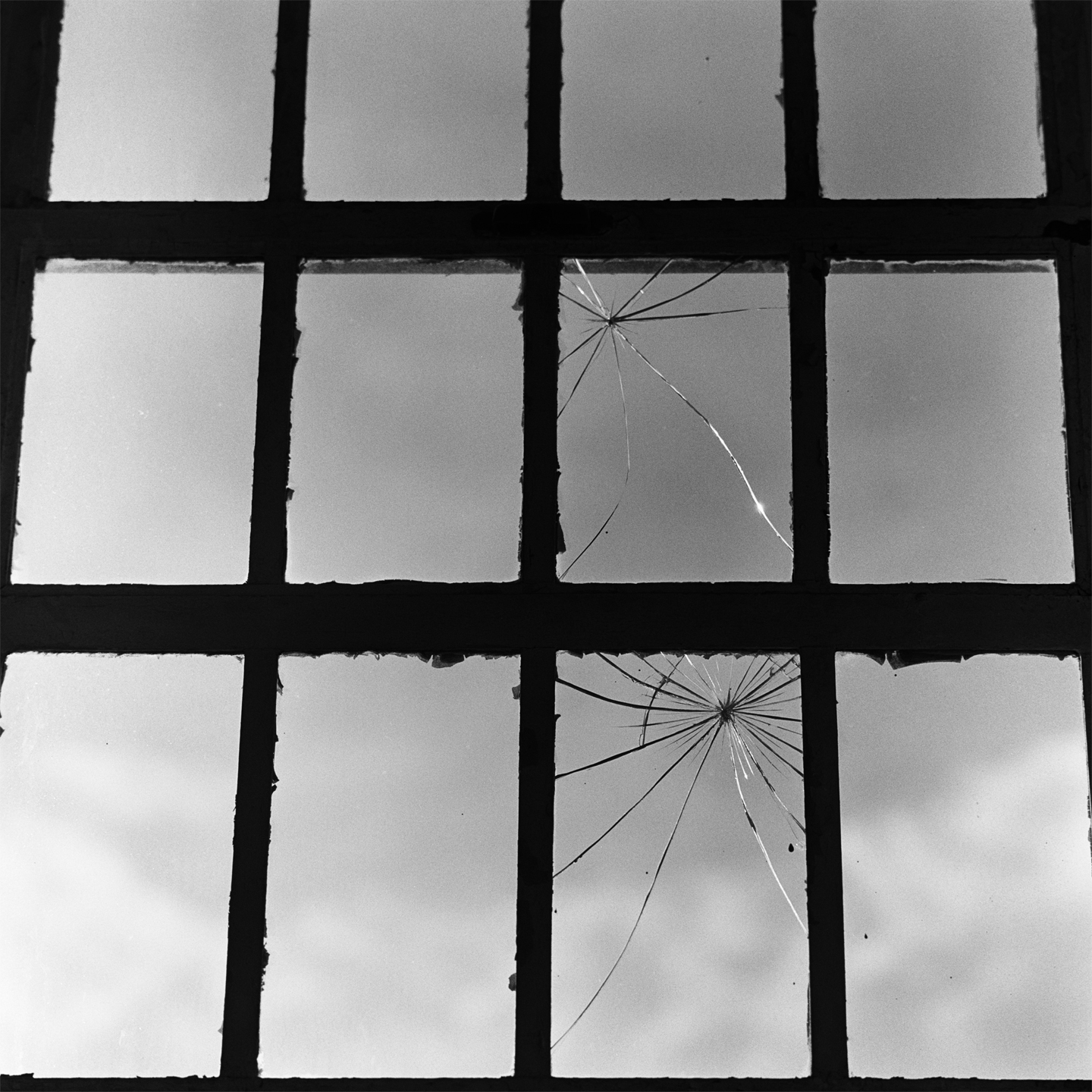
A few blog posts back, I mentioned that I was working on multiple projects; projects which had no set completion date; projects that might take a few years until I feel they're complete and ready for public viewing. I recently completed the second photo shoot for one of those projects. This project, in its' entirety, is far from completion; however, I want to talk about the recent shoot and share a few images. This will provide me with an outlet to discuss the project at various stages as well as provide you with a sneak peak into some of the images.
In June of this year, I visited the Mansfield Reformatory. It was a wonderful photographic journey which I shot entirely on Kodak Tri-X 400 black and white film. The reformatory and the experience I had photographing it inspired me to continue with that work. The research began and I started compiling a list of abandoned prisons and mental institutes that I would like to photograph. I'll be shooting these facilities on a variety of cameras, but I'll only be using Kodak Tri-X 400 film. The goal is to tell a story about each of these buildings through my final images as well as providing a look into the history of the correctional process of our nation. I'm not sure when this will be complete, but I can tell you that I do have another institute lined up before the end of the year.
On September 25, Brittany and I traveled to Weston, West Virginia. Weston is a very small town about 5.5 hours from Troy, Ohio. It's approximately 50 miles south of Morgantown. There's not much there, sans three hotels, a Walmart, a few fast food restaurants, a quaint downtown and a massive European structure known as the Trans-Allegheny Lunatic Asylum. According to their website, the Trans-Allegheny Lunatic Asylum was constructed between 1858 and 1881 and is the largest hand-cut stone masonry building in North America and is reportedly the second largest in the world, only behind the Kremlin. Richard Andrews designed the structure according to the Kirkbride plan (which influenced over 300 similar institutions over North America) and the original hospital was meant to hold 250 individuals. It opened to patients in 1864 and reached its' peak in the 1950s with 2,400 patients. In fact, it is rumored that Charles Manson actually spent some time at the facility, but there is no official record. Apparently the administrators used an alias for him because the community was outraged at the prospect of him being brought to the facility. Trans-Allegheny Lunatic Asylum was eventually closed in 1994; this was a mortal blow to the local economy and it's obvious that it's never quite recovered.
This structure is quite eerie, yet strikingly beautiful. I had scheduled 8 hours of shooting on Sunday; the first four to begin at 8 a.m. and end at 12 p.m. The final four from 2-6 p.m. We pulled up to the asylum around 7:20 a.m. and a heavy layer of fog surrounded the building. It was the perfect setting for exploring this abandoned treasure all day. My photography tour covered the main hospital, the grounds, the medical building, the geriatric building, the forensics facility and the women's center. All areas were in a complete state of decay, the outlying buildings more so than the hospital. Paint was peeling from the walls and ceilings, floors were reduced to dirt, ceiling tiles were hanging by a thread and debris was scattered everywhere. It's completely cliche, but if walls could talk in that facility, I'm sure they would have stories upon stories to tell. This structure was as I expected and it was the perfect follow-up to my Mansfield Reformatory shoot. I am very pleased with the images and I look forward to exploring more of these facilities as I continue with this project. For now, I've included a few of my final images.
Wednesday, October 12, 2011
Thursday, September 15, 2011
Instant Film Photography - The Rebirth?
Long before digital cameras came along, there was a different type of instant photography. Instant photography as we know it can generally be credited to Edwin Land, who unveiled the first commercial instant camera in 1948, 11 years after the Polaroid Corporation was founded. Edwin Land, a innovator and genius who has over 500 U.S. patents to his name, was inspired by his three year old daughter. She wanted to know why she couldn't see the picture he just took of her. Obviously, immediate gratification has been a character trait of the American people for a long time, as is evident with this example. Land initially developed instant film and then the mass market camera was released to the public a year later.
Polaroid enjoyed a long, successful run, but when the industry shifted to digital, they had a hard time competing and eventually filed for Chapter 11 in 2001. Everything, including the Polaroid name, was sold to a Bank One subsidiary. Instant cameras ceased to be produced by Polaroid in 2007 and the film was discontinued in 2009. This left many fans and users in a state of shock while putting thousands of perfectly good Polaroid cameras out of use. Fujifilm introduced their own line of instant photo products in 1981. They were allowed access to Polaroid's technology due to a technology share; Fuji's history with magnetic media was something Polaroid was interested in at the time. This allowed Fuji to continue their foray into instant photography. In 1999, Fuji launched the Instax integral series of instant photography products. These cameras and film are still produced today.
So, after this brief overview of instant photography, you may be wondering what the point is. Well, as I mentioned, I recently came across an article from the British Journal of Photography about Fujifilm and its' commitment to instant photography. Perhaps, it's a recommitment, since Fuji has been in the instant photography market since the 80s. I'm not going to quote the article verbatim, but it's essentially stating that Fujifilm is relaunching the Instax brand with a marketing campaign featuring a website and Facebook page that targets the 15-25 year old female market. Oliver Laurent, the author of the article, quotes Gabriel Da Costa, the product manager for Fujifilm as saying: "There's a whole generation who missed out on the 'golden age' of instant photography and we're confident that the Instax range will prove to be a big hit with today's tech-savvy youth." Here's a link to the whole article.
So, where does that leave us today and where does instant photography land in the scheme of things. First, let me say that instant photography can serve multiple and very different purposes. The thing that is great about instant photography is that it generates interest in traditional film photography. It's no secret that I've been enamoured with the world of film this past year and if it takes a Fuji Instax camera to create that interest for someone else, then so be it. An individual doesn't have to pick up a view camera to make film or their art relevant. It's simply a medium; just as painting has oils, acrylics, spray, water colors, etc. Film has instant, minox, 110, 35mm, 120, 4x5 and many other formats. Each artist can use whatever canvas they choose as long as they are happy and it helps them achieve their artistic vision. This is where I believe the different uses for instant photography come in. The Instax camera is being marketing towards an age group that will love taking the camera with them to parties, concerts, clubs, and wherever else they go to hang out and have fun. This camera will serve as a way to take those "photo booth" type pictures with their friends. Instant cameras can also be used to document family memories. Instead of taking hundreds of images that will never leave a digital screen, prints of a family Christmas or birthday can be made instantly. It's simply magic. That is what I see to be the first use of instant photography.
The second use of instant photography is to produce relevant photographic art. It blows my mind when individuals don't consider Polaroid or instant photography to be a valid form of photography. It's all about the vision of the artist. If the artist uses instant film as his/her canvas, and the vision is achieved, then what does it matter? Ansel Adams was a friend of Edwin Land and he helped Land perfect the film and cameras. In fact, he produced an amazing book of his Polaroids called Singular Images. Adams is a beloved photographer and was most famous for his large format, black and white, landscape work. Yet, he used an instant film to produce different, but altogether, stunning images. Who are we to judge what is a relevant format or not for an artist to use? It's said that beauty is in the eye of the beholder; Polaroid, and instant film provide a specific type of beauty and should be treated as such.
I guess what I'm getting at is that instant photography is a relevant form of art and photography and I hope that companies that get behind it can continue to keep the format relevant. Anyone that commits to a potentially defunct format in the name of art should be applauded. This allows an artist, such as myself, another way to flex my creativity. What irritates me about Fujifilm is the lack of recommitment to the other instant film that they produce. They still make Type 100 pack film for Polaroid Land Cameras. They produce a black and white film; FP-3000b, as well as a color film; FP-100c. There has been no announcement or indication that they will discontinue the film, but they've already quietly discontinued one of their other offerings about a year ago, the FP-100b. Thankfully, there are individuals like Michael Raso of the Film Photography Podcast that are trying to get these cameras and film into the hands of photographers all over the world. It would be a shame if all of the excitement and interest in Polaroid Land Cameras is for nought. I hope they decide that to fully commit to instant film, they need to continue to produce and market the Type 100 film. One would think that the success of the Impossible Project would be a contributing factor; while the two companies are at opposite ends of the spectrum when it comes to size, Fujifilm should look at the Impossible Project and learn how to spur a renewed interest in a format.
Instant photography was popular, became irrelevant to the general public and eventually faded into the background. The impossible has happened and instant film photography is back into the consumer conscience; it's a true form of art and I hope companies such as Fuji and the Impossible Project are able to provide this canvas for a very long time.
Sources: British Journal of Photography, Wikipedia
Polaroid enjoyed a long, successful run, but when the industry shifted to digital, they had a hard time competing and eventually filed for Chapter 11 in 2001. Everything, including the Polaroid name, was sold to a Bank One subsidiary. Instant cameras ceased to be produced by Polaroid in 2007 and the film was discontinued in 2009. This left many fans and users in a state of shock while putting thousands of perfectly good Polaroid cameras out of use. Fujifilm introduced their own line of instant photo products in 1981. They were allowed access to Polaroid's technology due to a technology share; Fuji's history with magnetic media was something Polaroid was interested in at the time. This allowed Fuji to continue their foray into instant photography. In 1999, Fuji launched the Instax integral series of instant photography products. These cameras and film are still produced today.
So, after this brief overview of instant photography, you may be wondering what the point is. Well, as I mentioned, I recently came across an article from the British Journal of Photography about Fujifilm and its' commitment to instant photography. Perhaps, it's a recommitment, since Fuji has been in the instant photography market since the 80s. I'm not going to quote the article verbatim, but it's essentially stating that Fujifilm is relaunching the Instax brand with a marketing campaign featuring a website and Facebook page that targets the 15-25 year old female market. Oliver Laurent, the author of the article, quotes Gabriel Da Costa, the product manager for Fujifilm as saying: "There's a whole generation who missed out on the 'golden age' of instant photography and we're confident that the Instax range will prove to be a big hit with today's tech-savvy youth." Here's a link to the whole article.
So, where does that leave us today and where does instant photography land in the scheme of things. First, let me say that instant photography can serve multiple and very different purposes. The thing that is great about instant photography is that it generates interest in traditional film photography. It's no secret that I've been enamoured with the world of film this past year and if it takes a Fuji Instax camera to create that interest for someone else, then so be it. An individual doesn't have to pick up a view camera to make film or their art relevant. It's simply a medium; just as painting has oils, acrylics, spray, water colors, etc. Film has instant, minox, 110, 35mm, 120, 4x5 and many other formats. Each artist can use whatever canvas they choose as long as they are happy and it helps them achieve their artistic vision. This is where I believe the different uses for instant photography come in. The Instax camera is being marketing towards an age group that will love taking the camera with them to parties, concerts, clubs, and wherever else they go to hang out and have fun. This camera will serve as a way to take those "photo booth" type pictures with their friends. Instant cameras can also be used to document family memories. Instead of taking hundreds of images that will never leave a digital screen, prints of a family Christmas or birthday can be made instantly. It's simply magic. That is what I see to be the first use of instant photography.
The second use of instant photography is to produce relevant photographic art. It blows my mind when individuals don't consider Polaroid or instant photography to be a valid form of photography. It's all about the vision of the artist. If the artist uses instant film as his/her canvas, and the vision is achieved, then what does it matter? Ansel Adams was a friend of Edwin Land and he helped Land perfect the film and cameras. In fact, he produced an amazing book of his Polaroids called Singular Images. Adams is a beloved photographer and was most famous for his large format, black and white, landscape work. Yet, he used an instant film to produce different, but altogether, stunning images. Who are we to judge what is a relevant format or not for an artist to use? It's said that beauty is in the eye of the beholder; Polaroid, and instant film provide a specific type of beauty and should be treated as such.
I guess what I'm getting at is that instant photography is a relevant form of art and photography and I hope that companies that get behind it can continue to keep the format relevant. Anyone that commits to a potentially defunct format in the name of art should be applauded. This allows an artist, such as myself, another way to flex my creativity. What irritates me about Fujifilm is the lack of recommitment to the other instant film that they produce. They still make Type 100 pack film for Polaroid Land Cameras. They produce a black and white film; FP-3000b, as well as a color film; FP-100c. There has been no announcement or indication that they will discontinue the film, but they've already quietly discontinued one of their other offerings about a year ago, the FP-100b. Thankfully, there are individuals like Michael Raso of the Film Photography Podcast that are trying to get these cameras and film into the hands of photographers all over the world. It would be a shame if all of the excitement and interest in Polaroid Land Cameras is for nought. I hope they decide that to fully commit to instant film, they need to continue to produce and market the Type 100 film. One would think that the success of the Impossible Project would be a contributing factor; while the two companies are at opposite ends of the spectrum when it comes to size, Fujifilm should look at the Impossible Project and learn how to spur a renewed interest in a format.
Instant photography was popular, became irrelevant to the general public and eventually faded into the background. The impossible has happened and instant film photography is back into the consumer conscience; it's a true form of art and I hope companies such as Fuji and the Impossible Project are able to provide this canvas for a very long time.
Sources: British Journal of Photography, Wikipedia
New Additions to the Blog
My solo show exhibit came down at the end of August and since I took it down, I've been thinking about my next steps as a photographer. The exhibit was a major focus of my photography in 2011; in fact, it was the culmination of my work for the past three years in addition to the exploration of myself and my creativity as a photographer. I don't want the exhibit to be it for me; I simply want it to be a starting point. I have a few projects that are currently in the works; I'm excited about them but I don't want to provide too much detail until I'm satisfied with the final product and I deem it ready for the public eye. The projects could take months or they could take years; just know that I'm working on a few things. That brings me to this blog; this blog has simply served as another outlet for me to talk about and display my work. I will continue to use it for that purpose, but I want it to grow, just as I have. So, I will be adding a few new dimensions to it.
First, I would like to incorporate more photography industry news. Rather than this site being strictly a form of self promotion, I would also like to include information that is important to other individuals. But, rather than rehashing articles and links from other sites, I would like to comment on the information and add my particular thoughts, opinions and angle regarding the subject.
Second, I am going to start a featured artist column/section. There are so many photographers, past and present, that provide inspiration and have shaped the world of photography as we know it today. Those individuals need to be recognized. Granted, a number of them have been immortalized in some way, but I would like to feature a different artist every week as an educational and inspirational tool for myself as well as others. I'm going to provide biographical info, images, the influence they've had on the art form, what I like/dislike about them and how they've inspired me or will inspire me. The individuals can range from well known greats like Ansel Adams to up and coming photographers that are just getting their start.
I'm excited about these changes and I hope they make the blog more of a destination site for everyone. With that being said, I plan to launch the first artist feature sometime next week. In regards to the news pieces, I'm going to start that today, with a recent article I found from the British Journal of Photography regarding instant photography. So, stay tuned for that piece later this afternoon.
First, I would like to incorporate more photography industry news. Rather than this site being strictly a form of self promotion, I would also like to include information that is important to other individuals. But, rather than rehashing articles and links from other sites, I would like to comment on the information and add my particular thoughts, opinions and angle regarding the subject.
Second, I am going to start a featured artist column/section. There are so many photographers, past and present, that provide inspiration and have shaped the world of photography as we know it today. Those individuals need to be recognized. Granted, a number of them have been immortalized in some way, but I would like to feature a different artist every week as an educational and inspirational tool for myself as well as others. I'm going to provide biographical info, images, the influence they've had on the art form, what I like/dislike about them and how they've inspired me or will inspire me. The individuals can range from well known greats like Ansel Adams to up and coming photographers that are just getting their start.
I'm excited about these changes and I hope they make the blog more of a destination site for everyone. With that being said, I plan to launch the first artist feature sometime next week. In regards to the news pieces, I'm going to start that today, with a recent article I found from the British Journal of Photography regarding instant photography. So, stay tuned for that piece later this afternoon.
Labels:
bios,
featured artist section,
history,
images,
new features,
News,
photography,
Photography blog
Monday, August 29, 2011
New Project Teaser
The bulk of my year has revolved around shooting images for Project 365, which requires me to shoot an image a day for an entire year. I'm 230+ days into the project and it's been a very trying, tough and at times, uncreative project. With that being said, it's also been a very satisfying project. I've shot images with my digital SLR, my iPhone and my various Polaroid cameras. It has been a great way to explore and develop my creativity. It's also been a tool to push myself as a photographer. What this project hasn't allowed me is extra time to focus on other photography projects, though I try to squeeze them in when I can. One of those projects is currently in development and will be one that comes to a close rather quickly, if I get the results that I hope for.
I've been experimenting with film this year and as I mentioned in my last post, I just obtained a Hasselblad 500 c/m camera. I've been shooting with it a great deal recently, and in that process I've developed a fondness for Adox CHS 50 ART black and white film. It's a very low speed, high grain, black and white emulsion. I really like the look it gives a scene and is perfect for the type of images that I like to create. The combination of the Hasselblad and the Adox are the tools that I'm using for the current project. The project involves portraiture, which is not one of the things I typically like to shoot. It's a step outside of the box for me, but I feel my subjects will make for great images.
As I stated earlier, this is not typical of my style. So, I welcome comments and/or critiques of my first attempt at portraiture. I look forward to sharing more of this type of work with you all, as well as the final product of this project.
I've been experimenting with film this year and as I mentioned in my last post, I just obtained a Hasselblad 500 c/m camera. I've been shooting with it a great deal recently, and in that process I've developed a fondness for Adox CHS 50 ART black and white film. It's a very low speed, high grain, black and white emulsion. I really like the look it gives a scene and is perfect for the type of images that I like to create. The combination of the Hasselblad and the Adox are the tools that I'm using for the current project. The project involves portraiture, which is not one of the things I typically like to shoot. It's a step outside of the box for me, but I feel my subjects will make for great images.
This is simply an inside look at what I'm hoping will be a very nice project once completed. I don't wish to share many additional details regarding the project at this time, I mainly wanted to give you a little teaser so you can see what's in store.
This also gives you an idea of the type of images that the Hasselblad 500 c/m and Adox CHS 50 ART film can produce.
As I stated earlier, this is not typical of my style. So, I welcome comments and/or critiques of my first attempt at portraiture. I look forward to sharing more of this type of work with you all, as well as the final product of this project.
Monday, August 8, 2011
Hasselblad 500 c/m!
I've had a bad case of Gear Acquisition Syndrome (GAS) this year. It started in January when my wife purchased a Polaroid SX-70 for my birthday. From there, I've accumulated numerous film cameras and I'm up to a total of 15 different makes and models. Some of them I haven't even shot yet. It's somewhat of an addiction. When you began diving into the world of film photography, you become aware of so many combinations to achieve your artistic vision. Cameras manufactured decades earlier are still relevant and in good condition. Most of them are in perfect working order or may need a simple CLA, but film can still be purchased and wonderful images can be created; all at a fraction of the cost of shooting digitally.
I'm in my infancy of using 120 medium format film; mostly shooting the roll film through my Lomography cameras, the Holga and the Diana F+. I've had great results, but I've been wanting to upgrade to a professional medium format camera. There are a number of great models out there, but there was just something about the iconic Hasselblad 500 c/m camera that I couldn't resist. Hasselblad is a name that's synonymous with quality and the 500 c/m was a completely interchangeable machine. The iconic box shape is not the only thing intriguing about this camera. It's truly a professional kit with a variety of interchangeable options. In addition to the lenses, if you don't like the focusing screen, you can change it. You don't like the viewfinder, change it; you want to switch from black and white film to color film mid roll, change it. It's a highly flexible system that produces gorgeously sharp 6x6 "square" negatives. So, after seeing some of the results on Flickr and reading about this camera and it's surprisingly cheap price point compared to today's digital standards, I just had to get one. I saved some money and perused eBay until I found a great deal from Columbus Camera Group. I couldn't resist and I ended up winning the auction.
It arrived a couple days later and actually handling this camera in person is better than I expected. It's well built; it's definitely not like holding a Holga in your hand. The camera is very particular and there are functions that I simply wasn't used to. A great deal of reading and researching was required before I could actually take this camera on a test run. After getting a good handle on the basic functions of my new Hasselblad, I was ready to take it for a spin. Unfortunately, for such a great camera, the only roll of film I had to run through it at the time was a roll of Lomography Red Scale. Not the ideal roll, but at least I was going to go shooting with this new toy. I had to pick up a few of my images that were hanging in the Gateway Arts Council Spring Fling Exhibit, so I thought I would swing by Tawawa Park afterwards and run that first roll through. I spent a couple hours wandering down paths and setting up shots. This was only the second time that I used a light meter and I had to get used to seeing the image reversed in the viewfinder. Regardless, it was a good time and I really enjoyed using the camera. The sound of shutter is magnificent and to hear it is simply enough to convince me to continue using the camera. After a couple of hours, I had finished the roll of film and I sent it off to my lab for processing. I received it back within a week and I was a little disappointed. While my exposures were pretty close, my shots weren't great and I just didn't get anything of outstanding quality. My negatives also came back heavily scratched. I had a bit of a freak out moment and thought something was wrong with my A12 back. I searched all over the Internet and found that Lomography Redscale film scratches easily. I couldn't be 100 percent certain that my film back was functioning properly until I ran another roll through. The FPP Midwest Meet Up was coming up in a few weeks, which made for the perfect opportunity to shoot the Hasselblad again.
This time I was armed with a roll of Adox 50 ISO black and white film. After the photo walk portion of the meet up, I ventured back out alone to do some additional shooting. I shot the entire roll, focusing mainly on urban and rural decay type shots. The roll came back from my lab without scratching and I was happy with some of the results. While I have a lot to learn and I still have to get used to this camera, I know I'm going to love it. I have a project that I'm going to be working on in August and I'll be using the same Adox film and the Hasselblad to complete it. If the results are as promising as I know they can be, I can't wait to share it with all of you. In the mean time, check out a few images from my second roll. Enjoy!
I'm in my infancy of using 120 medium format film; mostly shooting the roll film through my Lomography cameras, the Holga and the Diana F+. I've had great results, but I've been wanting to upgrade to a professional medium format camera. There are a number of great models out there, but there was just something about the iconic Hasselblad 500 c/m camera that I couldn't resist. Hasselblad is a name that's synonymous with quality and the 500 c/m was a completely interchangeable machine. The iconic box shape is not the only thing intriguing about this camera. It's truly a professional kit with a variety of interchangeable options. In addition to the lenses, if you don't like the focusing screen, you can change it. You don't like the viewfinder, change it; you want to switch from black and white film to color film mid roll, change it. It's a highly flexible system that produces gorgeously sharp 6x6 "square" negatives. So, after seeing some of the results on Flickr and reading about this camera and it's surprisingly cheap price point compared to today's digital standards, I just had to get one. I saved some money and perused eBay until I found a great deal from Columbus Camera Group. I couldn't resist and I ended up winning the auction.
It arrived a couple days later and actually handling this camera in person is better than I expected. It's well built; it's definitely not like holding a Holga in your hand. The camera is very particular and there are functions that I simply wasn't used to. A great deal of reading and researching was required before I could actually take this camera on a test run. After getting a good handle on the basic functions of my new Hasselblad, I was ready to take it for a spin. Unfortunately, for such a great camera, the only roll of film I had to run through it at the time was a roll of Lomography Red Scale. Not the ideal roll, but at least I was going to go shooting with this new toy. I had to pick up a few of my images that were hanging in the Gateway Arts Council Spring Fling Exhibit, so I thought I would swing by Tawawa Park afterwards and run that first roll through. I spent a couple hours wandering down paths and setting up shots. This was only the second time that I used a light meter and I had to get used to seeing the image reversed in the viewfinder. Regardless, it was a good time and I really enjoyed using the camera. The sound of shutter is magnificent and to hear it is simply enough to convince me to continue using the camera. After a couple of hours, I had finished the roll of film and I sent it off to my lab for processing. I received it back within a week and I was a little disappointed. While my exposures were pretty close, my shots weren't great and I just didn't get anything of outstanding quality. My negatives also came back heavily scratched. I had a bit of a freak out moment and thought something was wrong with my A12 back. I searched all over the Internet and found that Lomography Redscale film scratches easily. I couldn't be 100 percent certain that my film back was functioning properly until I ran another roll through. The FPP Midwest Meet Up was coming up in a few weeks, which made for the perfect opportunity to shoot the Hasselblad again.
This time I was armed with a roll of Adox 50 ISO black and white film. After the photo walk portion of the meet up, I ventured back out alone to do some additional shooting. I shot the entire roll, focusing mainly on urban and rural decay type shots. The roll came back from my lab without scratching and I was happy with some of the results. While I have a lot to learn and I still have to get used to this camera, I know I'm going to love it. I have a project that I'm going to be working on in August and I'll be using the same Adox film and the Hasselblad to complete it. If the results are as promising as I know they can be, I can't wait to share it with all of you. In the mean time, check out a few images from my second roll. Enjoy!
Tuesday, August 2, 2011
In the media!!
I haven't posted a great deal lately because I've been tied up with a few other things, namely my solo show that I announced about a month ago. So, I hope that's rectified in the coming months. Anyway, I've ran two rolls through my Hasselblad 500 c/m and I will be posting my thoughts on the camera, a few images and my upcoming projects with it by the end of this week. Until then, I was featured in a few things this past week and I wanted to pass those on to you.
First off, I attended the FPP Midwest Meet-up and Mat Marrash Gallery Show on July 15. As I mentioned in my review, it was a great time. During the meet-ups, Michael Raso typically interviews the individuals and I was lucky enough to sit down and chat with him a bit. The new Film Photography Podcast is live and it features a recap of that event. During that recap, my interview with Michael Raso is featured. My interview comes in around the 1:02:44 mark. Check out the Film Photography Project and download the newest podcast to hear my interview here.
My solo exhibit is now hanging in the gallery space at the Amos Memorial Public Library in Sidney, Ohio. It will be up the entire month of August and I'm having an opening reception on Thursday, August 4 from 6-8 p.m. So, stop by, check out my work, grab some refreshments and chat it up with me. Before then, check out the article that was featured in the Sidney Daily News yesterday here.
Thanks for reading and stay tuned for my Hasselblad images and post later this week!
First off, I attended the FPP Midwest Meet-up and Mat Marrash Gallery Show on July 15. As I mentioned in my review, it was a great time. During the meet-ups, Michael Raso typically interviews the individuals and I was lucky enough to sit down and chat with him a bit. The new Film Photography Podcast is live and it features a recap of that event. During that recap, my interview with Michael Raso is featured. My interview comes in around the 1:02:44 mark. Check out the Film Photography Project and download the newest podcast to hear my interview here.
My solo exhibit is now hanging in the gallery space at the Amos Memorial Public Library in Sidney, Ohio. It will be up the entire month of August and I'm having an opening reception on Thursday, August 4 from 6-8 p.m. So, stop by, check out my work, grab some refreshments and chat it up with me. Before then, check out the article that was featured in the Sidney Daily News yesterday here.
Thanks for reading and stay tuned for my Hasselblad images and post later this week!
Wednesday, July 20, 2011
The Future of Kodak
Kodak. A word, a brand; something that's been synonymous with photography for over a century. The Eastman Kodak Company was founded by George Eastman in 1892 and with it's establishment, essentially started an amateur photographer revolution and brought photography to a mass market.
Kodak has produced and continues to produce amazing photographic emulsions. The end of 2010 marked the end of an era, when Kodachrome ceased to be processed. Kodachrome was produced from 1935 to 2009 and was a color film much different from anything that proceeded it. Kodachrome had dye couplers added during processing, unlike other transparency and color negative films where they were actually incorporated in the emulsion layers. This was one of the first successfully marketed color films and became so wildly popular that Paul Simon even wrote and recorded a song that peaked at number two in the United States. It truly was something special and I'm sorry that I never got to shoot with the emulsion.
Like Kodachrome, Kodak is finding it hard to navigate in the increasingly competitive world of digital photography. A swift movement arrived and Kodak was caught with their pants down, so to speak. Their digital cameras have been left behind by the titans of Canon, Nikon and Pentax. They're also trying their hand at digital printing, but again, they are far from the market leader. They are now simply keeping the corporation a float and are in serious financial trouble. The Wall Street Journal featured an article yesterday about the steep decline of Kodak's bonds. Here's a link to the article.
It's a sad state of affairs and I hope they can refocus their energies and money on what they do best - film. The film photography world; correction, the photography world wouldn't be the same without Kodak. The same could be said about the loss of Polaroid. While Polaroid is still around, they no longer produce instant film and it's left a gaping hole in hearts and cameras. Thankfully, Fuji and Impossible Project are trying to fill that void. Who will fill the void if Kodak leaves? Let's hope it doesn't come to that and Kodak can some how continue developing great emulsions. I can't imagine shooting with out Tri-X. I urge every enthusiast and individual that still shoots film to continue buying Kodak film. I'm not sure how much it will help, but it surely can't hurt. I can't imagine photography without Kodak and I hope I don't have to.
Kodak has produced and continues to produce amazing photographic emulsions. The end of 2010 marked the end of an era, when Kodachrome ceased to be processed. Kodachrome was produced from 1935 to 2009 and was a color film much different from anything that proceeded it. Kodachrome had dye couplers added during processing, unlike other transparency and color negative films where they were actually incorporated in the emulsion layers. This was one of the first successfully marketed color films and became so wildly popular that Paul Simon even wrote and recorded a song that peaked at number two in the United States. It truly was something special and I'm sorry that I never got to shoot with the emulsion.
Like Kodachrome, Kodak is finding it hard to navigate in the increasingly competitive world of digital photography. A swift movement arrived and Kodak was caught with their pants down, so to speak. Their digital cameras have been left behind by the titans of Canon, Nikon and Pentax. They're also trying their hand at digital printing, but again, they are far from the market leader. They are now simply keeping the corporation a float and are in serious financial trouble. The Wall Street Journal featured an article yesterday about the steep decline of Kodak's bonds. Here's a link to the article.
It's a sad state of affairs and I hope they can refocus their energies and money on what they do best - film. The film photography world; correction, the photography world wouldn't be the same without Kodak. The same could be said about the loss of Polaroid. While Polaroid is still around, they no longer produce instant film and it's left a gaping hole in hearts and cameras. Thankfully, Fuji and Impossible Project are trying to fill that void. Who will fill the void if Kodak leaves? Let's hope it doesn't come to that and Kodak can some how continue developing great emulsions. I can't imagine shooting with out Tri-X. I urge every enthusiast and individual that still shoots film to continue buying Kodak film. I'm not sure how much it will help, but it surely can't hurt. I can't imagine photography without Kodak and I hope I don't have to.
Subscribe to:
Posts (Atom)